Bedroom Lighting That Feels Warm Instead of Harsh
August 30, 2026
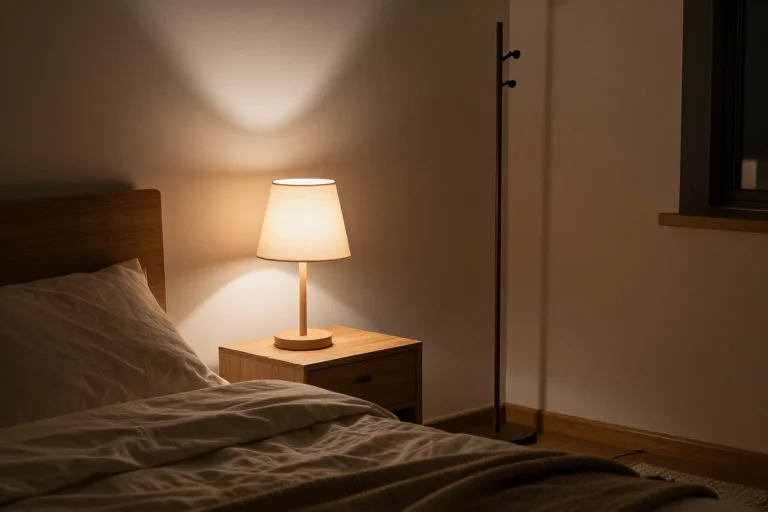
A bedroom can have beautiful bedding, thoughtful furniture, and the right colors — and still feel wrong at night.
Often, the problem is lighting.
One bright ceiling light can make a bedroom feel functional when what you actually want is soft, quiet, and comfortable.
The solution is not necessarily more light.
It is better-controlled light.
For a warmer evening bedroom, think in layers rather than relying on a single fixture.
Why bedroom lighting feels harsh
Many bedrooms are designed around one central ceiling fixture.
It is practical, but it creates a very specific atmosphere: bright, even, and functional.
That is useful when you are cleaning, getting dressed, or looking for something.
It is less useful when you want the bedroom to feel calm after dark.
Design guidance published recently by The Spruce similarly emphasizes warm-toned bulbs, dimmable lighting, and multiple light sources when creating a more relaxing bedroom atmosphere.
The three layers of bedroom lighting
A useful bedroom lighting system has three basic layers.
1. Ambient lighting
This is the overall illumination of the room.
A ceiling fixture can still provide it.
The important part is giving yourself the ability to reduce its intensity or turn it off when you do not need bright light.
2. Task lighting
This is focused light for something you are actually doing.
In a bedroom, this might be:
- Reading
- Getting dressed
- Working at a desk
- Looking for something in a drawer
A bedside lamp is one of the most useful examples.
3. Accent lighting
Accent lighting exists mainly to create atmosphere.
It might be:
- A small table lamp
- A floor lamp
- A wall light
- A subtle decorative lamp
You do not need many.
One carefully positioned light can create a surprisingly large change.
Why warm light works so well in bedrooms
Warm light tends to feel softer and more intimate than cool, bright illumination.
Rather than making every corner equally bright, use light to create zones.
For example:
Bedside lamp → reading area
Floor lamp → empty corner
Accent light → artwork or wall
The result is a room where the eye naturally moves between pools of light instead of being hit with one bright source.
Try turning off the ceiling light
This is one of the simplest experiments you can do.
At night, turn off your overhead fixture.
Then switch on your bedside lamp and another small light across the room.
Look at the room from the doorway.
You may immediately notice that the bedroom feels more dimensional.
Nothing changed except the lighting.
That is the power of layered illumination.
Where should bedroom lamps go?
Start with the bedside area.
A bedside lamp should be easy to reach and visually proportional to your nightstand.
Then look for one secondary location.
A floor lamp works particularly well in:
- Reading corners
- Empty corners
- Next to a chair
- Beside a dresser
The goal is not to illuminate every square foot.
The goal is to give the room enough variation that it does not feel flat.
Warm lighting does not mean making everything orange
There is an important distinction between warm and overly warm.
A bedroom should still feel natural.
You want a soft evening atmosphere, not a room that looks artificially orange.
This is another reason multiple lower-intensity lights can work better than one extremely bright or extremely warm source.
The atmosphere comes from intensity + placement + color temperature, not color temperature alone.
What about smart bulbs?
Smart bulbs can be useful because they allow you to change brightness and warmth without changing the fixture.
But you do not need smart lighting to create a warm bedroom.
A simple bedside lamp with an appropriate warm bulb can already transform the room.
Start simple.
Upgrade later if you discover you want more control.
A practical bedroom lighting setup
For a small or medium bedroom, try this:
Primary light: existing ceiling fixture
Bedside: one or two warm table lamps
Secondary zone: one floor lamp or accent light
Optional: dimmable or smart lighting for easier control
During the day, use your brighter sources.
At night, rely primarily on the lower, warmer lights.
The bedroom then naturally changes character as the day progresses.
What should bedroom lighting look like at night?
A good test is whether the room still feels comfortable when viewed from across the room.
You should not immediately notice the bulb.
You should notice the atmosphere.
That usually means avoiding naked, overly bright bulbs and focusing attention on where the light lands rather than simply how much light the bulb produces.
Frequently asked questions
What is the best lighting for a bedroom at night?
Layered, warm, low-intensity lighting is a strong starting point. Use bedside lighting for practical tasks and one additional light source to create depth.
Are warm bulbs better for bedrooms?
Warm-toned bulbs are commonly used in bedrooms because they create a softer evening atmosphere. Dimming is also useful because brightness can matter as much as color temperature.
Should I use a ceiling light in my bedroom?
Yes. It is practical for general illumination. The issue is relying on it as the only source of light.
How many lamps should a bedroom have?
There is no fixed number. One bedside lamp plus one secondary light source can already create much better visual layering than a single ceiling light.
Build the scene
Our Warm Night Bedroom scene is built around the idea that your bedroom should feel different after sunset.
Lower light.
Softer contrast.
Warm materials.
A few deliberate pools of illumination.
Not brighter.
Just better.
Explore the Warm Night Bedroom scene →
See it put together
Warm Night Bedroom
A softer evening bedroom built around low, warm light and a quieter atmosphere after sunset.
Explore this scene →