How to Make a Bedroom Feel Warmer and More Relaxing at Night
August 3, 2026
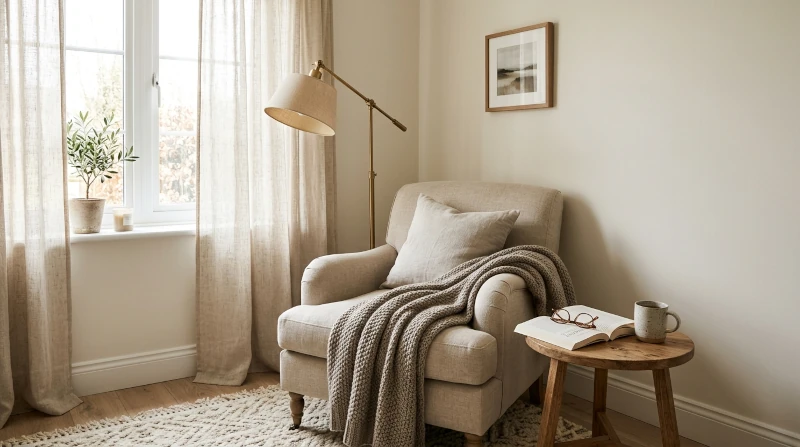
If your bedroom feels comfortable during the day but harsh or flat after sunset, the problem may be the lighting rather than the furniture. Start by reducing your dependence on overhead light and adding two or three smaller, warmer sources of illumination around the room.
The goal is to create a different version of the bedroom after dark.
The short answer
For a warmer bedroom at night:
- turn off the main ceiling light when possible
- use a dimmable bedside lamp
- add a second low-level light source
- choose warm-white rather than daylight-toned light
- keep the rest of the room visually soft and uncluttered
This is consistent with recent home-community discussions where warm, low-level lighting is repeatedly described as changing how a room feels after dark. One recent discussion specifically noted that lighting from below creates a noticeably different nighttime atmosphere from daytime lighting. (Reddit)
Why your bedroom can feel different after sunset
Natural daylight gives a room variation.
Light comes through windows, reflects off walls, changes throughout the day, and creates shadows.
At night, many bedrooms replace that variation with one source:
the ceiling light.
That makes everything equally visible.
The result can feel bright, flat, and functional rather than calm.
Warm Night Bedroom design takes the opposite approach:
less general illumination, more intentional pools of light.
Use the bedside lamp as the first layer
Your first lamp should be close enough to the bed to create a comfortable local light source.
A good bedside lamp should ideally have:
- warm output
- soft diffusion
- a compact footprint
- a shade or diffuser
- dimming capability
You don't need an expensive designer lamp.
What matters is the quality and position of the light.
Add a second light source
One bedside lamp can still leave the rest of the room visually empty.
A second light source creates depth.
This can be:
- a slim floor lamp
- a small table lamp
- a wall-mounted plug-in light
- another low-level ambient light
It does not need to be bright.
Its job is simply to create another area of warmth.
Recent home discussions show how people use several small lamps around a room specifically to create a softer nighttime atmosphere rather than relying on one main fixture. (Reddit)
Choose warmth over brightness
The exact bulb choice depends on the fixture and personal preference, but a warm-white range is a useful starting point for an evening bedroom.
Common searches include:
- 2700K warm light bulb
- dimmable warm white bulb
- warm bedside lamp
- 2200K warm bulb
The number matters less than the overall result:
the bedroom should look warm rather than blue-white.
Don't forget the surfaces around the light
A lamp does not exist independently.
Warm light becomes more effective when it falls on:
- cream bedding
- warm wood
- beige walls
- natural textiles
- soft rugs
Hard glossy surfaces can bounce light very differently from linen, cotton, or matte wood.
That is why the Warm Night Bedroom scene works as a combination rather than a single lighting product.
Add one soft evening layer
A throw blanket at the foot of the bed is a useful example.
It doesn't need to be thick or oversized.
Its role is to add:
softness + texture + visual depth
A neutral cotton or linen throw is usually easier to integrate than a highly decorative pattern.
A simple Warm Night setup
You do not need to recreate an entire hotel room.
Start with:
one dimmable bedside lamp
one secondary ambient lamp
one warm light source
one soft textile layer
Then turn off the ceiling light.
The difference can be surprisingly large.
FAQ
What color temperature is best for a cozy bedroom at night?
A warm-white range is a useful starting point, particularly around the 2200K–2700K range for an evening-oriented atmosphere. Dimming and diffusion matter as well.
Should I turn off my bedroom ceiling light at night?
Not necessarily every time. The point is to have alternatives when you want a softer atmosphere, rather than making the ceiling fixture the only usable light.
How many lamps does a bedroom need?
There is no universal number. One bedside lamp can work, while a second ambient source can add depth in a larger bedroom.
See it put together
Warm Night Bedroom
A softer evening bedroom built around low, warm light and a quieter atmosphere after sunset.
Explore this scene →