How to Make a Minimalist Bedroom Feel Warm and Personal
September 1, 2026
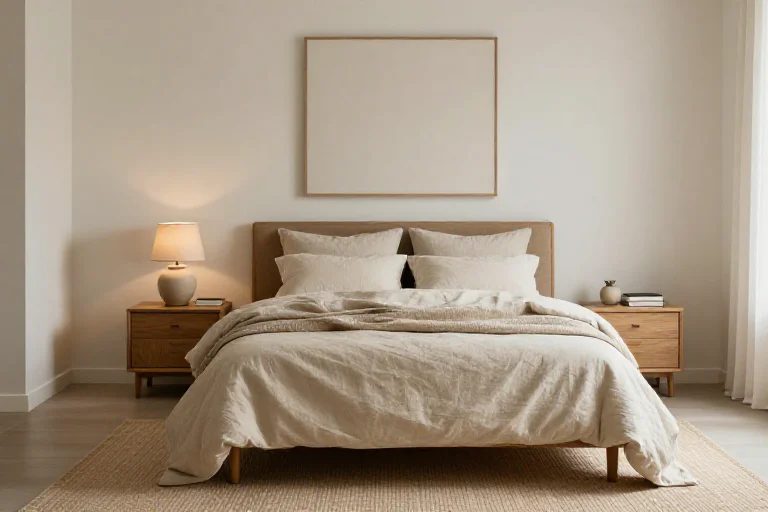
Minimalism sounds simple.
In practice, it can be surprisingly difficult.
Remove too much and the bedroom starts to feel empty.
Add too much and the calm disappears.
The sweet spot is not an empty bedroom.
It is a bedroom where everything visible feels intentional.
That is the foundation of a warm minimalist bedroom.
Recent design coverage increasingly frames minimalist bedrooms this way: fewer distractions, warm materials, layered texture, thoughtful lighting, and enough personality to keep the room from feeling sterile.
Minimalist does not mean empty
A minimalist bedroom can still contain:
- Artwork
- Books
- Rugs
- Curtains
- Plants
- Soft bedding
- Wood furniture
- Lamps
- Personal objects
The difference is that these elements are edited.
Instead of asking:
“What else can I add?”
Ask:
“What does this room actually need?”
That one question changes the design process.
Start with visual clutter
The fastest way to make a bedroom feel more minimalist is often to reduce what is visible.
Look at your:
- Nightstand
- Dresser
- Desk
- Open shelves
- Floor
- Bed
What items are always visible?
Now separate them into three groups:
Used every day
Useful but can be stored
Decorative
The first group can stay visible.
The second group should probably have a home.
The third group should be limited to the pieces you genuinely like.
This creates calm without forcing you to own less than you actually need.
Use texture instead of decoration
This is one of the most important ideas in warm minimalism.
A room can have very few objects and still feel visually rich.
Texture creates that richness.
Try combinations such as:
Linen + wood
Wool + cotton
Matte ceramic + timber
Woven fiber + smooth walls
Soft bedding + structured furniture
The room gains depth without gaining clutter.
Architectural Digest similarly recommends warm neutrals, natural materials, selective decor, and texture as ways to maintain a minimalist bedroom without making it feel bare.
Warm up a neutral color palette
Neutral does not have to mean white.
Warm minimalist bedrooms often work well with:
- Cream
- Beige
- Taupe
- Warm gray
- Sand
- Oatmeal
- Soft brown
- Muted sage
Use several related shades rather than trying to make everything exactly the same.
For example:
Cream bedding
Warm beige wall
Light oak furniture
Oatmeal rug
Dark brown accent
The palette remains restrained, but it still has depth.
Choose one visual focal point
Minimalist bedrooms become difficult when every object is competing for attention.
Instead, choose one main element.
It could be:
- The bed
- A large artwork
- A textured wall
- A beautiful lamp
- A wood headboard
- A statement chair
Then keep surrounding elements quieter.
This creates hierarchy.
The room feels designed rather than simply sparse.
Leave some surfaces empty
An empty nightstand surface is not wasted space.
It is visual breathing room.
The same is true for a dresser.
You do not have to fill every shelf simply because the shelf exists.
In minimalist design, negative space is part of the composition.
It allows the things you choose to remain visible to matter more.
Add personality deliberately
One of the biggest problems with minimalist bedrooms is that they can become generic.
The solution is not adding twenty decorations.
It is choosing one or two things that are unmistakably yours.
A favorite photograph.
A vintage lamp.
A ceramic object.
A stack of books.
A handmade textile.
A piece of artwork.
Minimalism becomes much more interesting when the room reflects the person living in it.
How to make minimalism feel cozy
Use this formula:
Fewer objects + warmer materials + softer lighting + more texture + one personal element.
That gives you a bedroom that feels calm without feeling impersonal.
Frequently asked questions
How do I make my minimalist bedroom cozy?
Use warm neutrals, tactile materials, layered lighting, soft bedding, and one or two personal details. Minimalism is about editing, not eliminating comfort.
Why does my minimalist room feel cold?
Common reasons include too much white, cool lighting, hard materials, excessive empty space, or a lack of texture.
Can a minimalist bedroom have decorations?
Absolutely. The key is selecting a small number of meaningful or visually strong pieces instead of filling every surface.
What colors work best for a warm minimalist bedroom?
Cream, beige, oatmeal, taupe, warm gray, natural wood, muted green, and other soft earthy tones are good starting points.
Build the scene
Our Calm Minimal Bedroom scene is designed around fewer visible distractions without sacrificing comfort.
Simple does not have to mean empty.
Quiet does not have to mean boring.
The best minimalist bedroom is often the one that makes you notice what remains.
Explore the Calm Minimal Bedroom scene →
See it put together
Calm Minimal Bedroom
A quieter bedroom built around fewer visible distractions, restrained colors, and a few intentional pieces.
Explore this scene →