How to Make Your Bedroom Feel Darker and Moodier Without Repainting
August 25, 2026
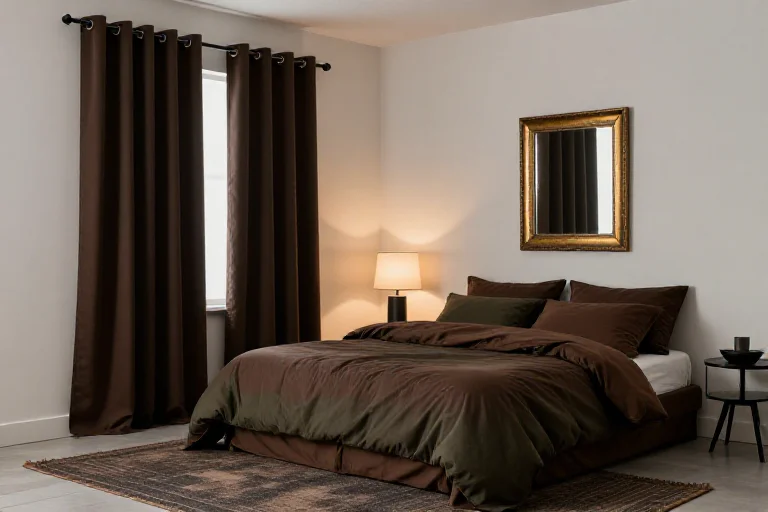
You do not necessarily need to paint your bedroom dark to make it feel darker.
In fact, repainting is often one of the least convenient ways to experiment with a moody bedroom style. It creates more work, changes the room permanently, and does not solve the biggest problem at night: the lighting and visual layers may still feel too bright or disconnected.
A better approach is to change the elements you see and use most.
The bed, lighting, curtains, rug, and a few accents can shift the entire mood while leaving the walls alone.
Start With Darker Bedding
Changing the duvet cover is usually the fastest way to introduce a darker palette.
Because the bed occupies so much visual space, a darker duvet can make the room feel significantly deeper even when the walls remain white or beige.
Try:
- charcoal
- espresso
- deep taupe
- muted olive
- warm brown
- faded black
Avoid choosing a very saturated color simply because you want the room to feel dramatic.
A desaturated dark tone is usually easier to live with and easier to combine with existing furniture.
Turn Down the Lighting Before Buying More Decor
If the bedroom still looks bright after changing the bedding, look at the lighting.
A cool ceiling light can undo almost everything else.
Start by changing the evening lighting routine.
Use a warm bedside lamp instead of the main ceiling fixture.
Then add a focused reading light if you have a chair or reading area.
The room does not need to become dark everywhere.
It needs to have enough contrast between the areas you actively use and the areas you do not.
For more detail, see How to Create Cozy Ambient Lighting in a Dark Bedroom.
Use Curtains to Make the Room Feel More Enclosed
You can also change the perception of the room with window treatments.
Floor-length curtains in charcoal, chocolate, taupe, muted olive, or another deeper neutral can make the window feel more substantial.
This is especially useful if your bedroom currently has very pale curtains that visually disappear.
The curtains do not need to be black.
They simply need to introduce a richer layer.
A matte or textured fabric usually looks more natural than a shiny synthetic finish.
Add a Rug Instead of Replacing the Floor
A rug can make an unexpectedly large difference.
If the bedroom has a very light wood, tile, or laminate floor, a warmer neutral rug can introduce visual weight without making the room feel smaller.
Try:
- faded charcoal
- warm taupe
- oatmeal
- muted brown
- low-contrast vintage patterns
The rug should support the darker bedding rather than compete with it.
Texture matters as much as color.
A woven or slightly distressed surface can make the room feel more layered without adding more objects.
Add One or Two Warm Accents
A dark bedroom can sometimes become visually flat when all of the surfaces are matte.
This is where a restrained warm accent helps.
Aged brass is especially effective.
Instead of buying several metallic decorations, try one:
- brass-framed mirror
- aged metal lamp
- antique-style picture frame
- small brass tray
- vintage-inspired hardware
The goal is contrast, not decoration.
One warm reflective element can catch the light and make the rest of the darker palette feel richer.
Keep the Existing Furniture
This is where the biggest savings can happen.
You do not need to replace the bed frame, dresser, or nightstands simply because you want a different aesthetic.
Warm wood furniture works particularly well with dark bedding.
Even lighter wood can work when paired with charcoal, brown, olive, and warm lighting.
Instead of asking:
"What furniture should I replace?"
ask:
"Which visible layer currently makes the room feel too bright or generic?"
Then change that layer first.
A Low-Effort Moody Bedroom Formula
For a simple transformation, try this sequence:
Step 1: Change the bedding
Use one deep neutral tone.
Step 2: Change the evening lighting
Replace bright overhead lighting with warm local light.
Step 3: Darken the window treatment
Add richer curtains if the room still feels visually bright.
Step 4: Ground the room
Use a warm neutral or low-contrast rug.
Step 5: Add one reflective accent
Aged brass or antique-style metal provides warmth and contrast.
This is enough to create a noticeably different bedroom without repainting.
What Not to Do
The easiest way to overshoot the look is to change everything at once.
Avoid adding:
- multiple accent colors
- several metallic finishes
- heavy black furniture
- high-contrast patterned bedding
- excessive wall decor
- many different lighting colors
A moody bedroom is usually stronger when the palette is narrow.
For example:
charcoal + warm taupe + natural wood + aged brass
is enough.
You do not need ten different decorative colors to make the room interesting.
The Result Should Still Feel Like Your Bedroom
This is the most useful test.
After the changes, does the room still feel natural during the day?
Does the furniture still make sense?
Does the bedroom become more atmospheric at night without becoming difficult to use?
If the answer is yes, the refresh is working.
The objective is not to create a permanently dark room.
It is to create a room that feels warmer and more immersive when you actually use it in the evening.
See it put together
Moody Dusk Bedroom
An intimate space wrapped in richer tones and low-lit warmth, created for night owls and cozy evening unwinding.
Explore this scene →