What Should You Keep on a Bedroom Nightstand?
September 10, 2026
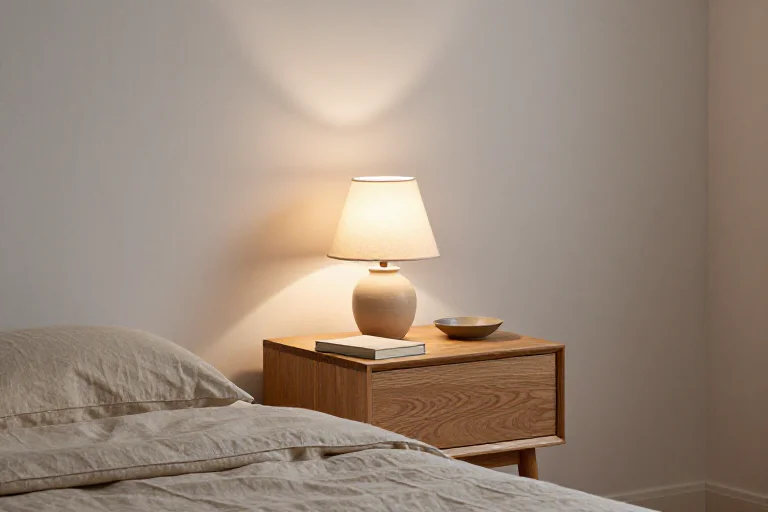
A nightstand does not need to be a miniature storage unit.
It also does not need to be perfectly styled with a candle, vase, stack of books, and decorative object.
Its job is much simpler:
Keep the things you actually need close to the bed.
The problem is that the nightstand is also one of the easiest places for clutter to accumulate.
Phone.
Charger.
Water.
Glasses.
Book.
Earbuds.
Medication.
Random receipts.
A few things become ten things very quickly.
A better nightstand starts with understanding what you actually use.
Start with your nighttime routine
Before buying a new bedside table or organizing the existing one, think about what happens during the last 30 minutes before you sleep.
What do you reach for?
Maybe it is:
- Your phone
- A book
- Glasses
- Water
- E-reader
- Headphones
- Hand cream
- Alarm clock
Those are your real bedside essentials.
Everything else can probably live somewhere else.
This sounds obvious, but it changes how you choose a nightstand.
You are not looking for the most beautiful table.
You are looking for a surface and storage arrangement that fits your routine.
Keep the top surface simple
A useful nightstand usually needs surprisingly little on top.
A good starting point is:
Lamp
One or two everyday items
Small tray or dish
That's it.
For example:
- Table lamp
- Current book
- Small water glass
The tray can contain smaller objects such as earbuds or jewelry.
This keeps the individual objects from spreading across the entire surface.
Why a bedside lamp matters
The lamp is often the most useful object on a nightstand because it solves both a practical and visual problem.
Practically, it gives you light without turning on the ceiling fixture.
Visually, it creates a lower point of light in the room.
That matters at night.
A bright overhead light makes the whole bedroom equally bright.
A bedside lamp creates a smaller, softer zone.
This is particularly useful if you want a warmer bedroom atmosphere.
What about books?
Books are one of the few decorative objects that can also communicate something about how you use the room.
Keep the book you are currently reading nearby.
There is no need to create a perfectly arranged stack of ten books if you only read one.
If you regularly read before bed, a slightly larger nightstand may make sense—especially if you’re trying to create a bedroom reading corner you’ll actually use.
If you do not, you may prefer a smaller surface.
Your furniture should follow your habits.
How much storage do you need?
This depends on what you keep beside the bed.
A drawer is useful for things you want nearby but do not want visible.
Examples include:
- Charging cables
- Glasses
- Personal items
- Earbuds
- Reading accessories
Open shelving works better for things you access frequently.
But open storage also creates visual clutter more easily.
If you prefer a calm minimalist bedroom, a drawer or closed compartment can be particularly useful.
What if you have a very small bedroom?
You do not necessarily need a traditional nightstand.
Depending on the layout, you could use:
- Small side table
- Narrow bedside table
- Wall-mounted shelf
- Floating nightstand
- Small stool
The important question is not:
“Does this look like a nightstand?”
It is:
“Can it comfortably hold the things I need beside the bed?”
A small surface that works is better than a large piece of furniture that makes the room harder to move through.
Should both nightstands match?
No.
Matching nightstands create symmetry, but they are not mandatory.
If the two sides of the bed have different needs, the furniture can reflect that.
One side might need:
Lamp + book + drawer
The other might only need:
Lamp + water
Different tables can work as long as they share some visual relationship.
For example, similar wood tones or similar proportions can make them feel connected.
The three-zone nightstand
A simple way to organize the surface is to think in three zones.
Light
Your bedside lamp.
Essential
The things you use every night.
Personal
One thing you genuinely like.
That personal object might be:
- Small artwork
- Favorite book
- Ceramic object
- Photograph
You do not need five decorative pieces.
One is enough.
What should not live on your nightstand?
If you do not use something at night, ask why it is there.
Common sources of clutter include:
- Old receipts
- Packaging
- Empty cups
- Multiple decorative objects
- Unused cables
- Products you rarely use
The nightstand is often a good place to practice one simple rule:
If it does not support your nighttime routine, it probably does not need to be visible.
The ideal nightstand is personal
There is no universal list of things every bedroom needs.
Someone who reads every night needs a different setup from someone who watches videos in bed.
Someone who wakes up with a glass of water needs a different surface from someone who does not.
The best bedside table is therefore not the one that looks best in a showroom.
It is the one that disappears into your routine.
You reach for something.
It is there.
You turn off the light.
Everything you need is within reach.
Nothing else is demanding your attention.
Frequently Asked Questions
What should I put on my nightstand?
Start with a lamp and the few things you actually use before sleeping, such as a book, water, glasses, or phone.
How do I keep my nightstand from getting cluttered?
Keep everyday items limited to the surface and move less frequently used items into drawers or other storage.
Does a nightstand need drawers?
No. Drawers are useful for hiding small items, but a simple table can work if you have few bedside essentials.
What can I use instead of a nightstand?
A narrow side table, floating shelf, stool, or compact bedside table can all work depending on your bedroom layout.
The Scene Connection
Our Calm Minimal Bedroom scene treats the nightstand as part of the room's quiet rather than another place to display things.
A useful lamp.
A book.
A small personal detail.
Enough space to put down your phone.
Sometimes that is all a bedside table needs.
Explore the Calm Minimal Bedroom →
See it put together
Calm Minimal Bedroom
A quieter bedroom built around fewer visible distractions, restrained colors, and a few intentional pieces.
Explore this scene →