Why Does My Bedroom Feel Cold Even When It Looks Nice?
September 7, 2026
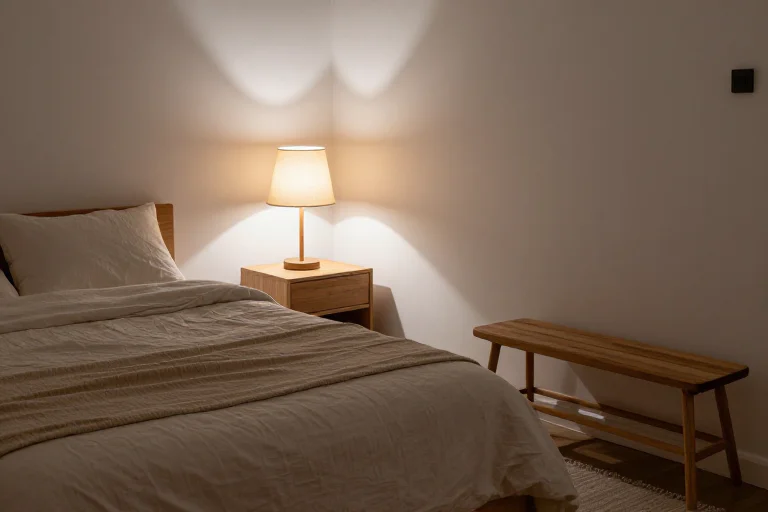
Some bedrooms look good in photographs but feel strangely uncomfortable when you actually spend time in them.
The colors are neutral.
The furniture is attractive.
The room is clean.
Everything seems to be in the right place.
But something feels cold.
If that sounds familiar, the problem may not be your furniture.
It may be the combination of light, texture, materials, and visual temperature.
This is also a common reason why a bedroom feels cold even when it looks nice.
This is especially common in bedrooms that rely heavily on white, gray, smooth surfaces, and one bright ceiling fixture.
The good news is that you usually do not need to redesign the entire room.
“Cold” does not always mean the temperature
When people describe a room as cold, they are often talking about how the room feels visually.
A bedroom can feel cold because of:
- Cool white lighting
- Hard surfaces
- Too much gray
- Bare floors
- Smooth bedding
- Minimal texture
- Excessive empty space
- Furniture with little material variation
The room may be physically comfortable.
It simply does not communicate comfort very well.
Start with the light
Before changing paint or furniture, look at your lighting.
This is probably the highest-impact adjustment.
A recent bedroom discussion with more than a thousand upvotes centered almost entirely on lighting. Multiple commenters recommended warmer bulbs and replacing the dominant overhead light with lower lamps.
Another recent discussion made the same point: the user wanted a warmer, calmer bedroom without adding clutter, and commenters again focused heavily on warm lamps rather than additional decoration.
This is a useful lesson:
If the room feels cold, do not automatically buy more stuff.
Try changing the light first.
If you want to go deeper into this, it helps to look at bedroom lighting that feels warm instead of harsh.
Replace one harsh light with two softer ones
You do not have to remove your ceiling fixture.
Keep it for practical situations.
Instead, add:
One bedside lamp
and
One secondary lamp
The secondary lamp could be:
- Floor lamp
- Small table lamp
- Wall light
- Reading lamp
Then use the smaller lights when you want the bedroom to feel relaxed.
The difference can be dramatic.
Add texture before adding color
If your bedroom is mostly neutral, you may be tempted to introduce a strong color.
That can work.
But texture is often the better first move.
Try:
- Linen duvet
- Chunky throw
- Wool or woven rug
- Textured curtains
- Woven basket
- Wood furniture
- Soft upholstered chair
These materials create visual warmth without forcing a new color palette.
Wood is an easy warmth multiplier
If a bedroom feels too sterile, natural wood can help immediately.
You do not need a complete wooden furniture set.
One or two pieces can be enough.
A wood nightstand.
A wooden bench.
A simple oak frame.
A small stool.
The purpose is to introduce a material that feels warmer and more tactile than painted or glossy surfaces.
This is one reason natural bedroom design works so well with cozy interiors.
The room becomes warmer without becoming visually complicated.
Look at the floor
Bare flooring can make a bedroom feel surprisingly unfinished.
This is particularly noticeable when the rest of the room is minimal.
A rug introduces:
- Texture
- Softness
- Visual weight
- Warmth
- A defined zone around the bed
Recent Reddit discussions about making bedrooms cozier repeatedly bring up rugs as one of the first high-impact changes, especially alongside curtains and bedding.
If you do not want a large rug, even a strategically placed runner can change how the room feels underfoot.
Your bedding matters more than you think
The bed is usually the largest visual object in a bedroom.
If the bedding looks flat, thin, or overly crisp, the entire room can feel less comfortable.
You do not need excessive layers.
Try:
Comfortable duvet
-
Two or three pillows
-
One textured throw
The goal is softness.
Not decoration.
Add one thing that looks lived-in
A bedroom can become so carefully styled that it stops looking like somewhere a person lives.
Books can help.
A small stack on a nightstand.
A favorite object.
A framed photograph.
A chair with a folded blanket.
These details introduce personality.
They tell the eye that the room is not simply designed.
It is inhabited.
But do not confuse warmth with clutter
This is where many cozy-bedroom makeovers go wrong.
The response to a cold room is often:
“Add plants.”
“Add candles.”
“Add pillows.”
“Add baskets.”
“Add artwork.”
“Add shelves.”
Eventually the room contains more objects but still does not feel comfortable.
Warmth is not the same thing as quantity.
A better approach—one that focuses on making a bedroom feel cozy without adding more stuff—is:
One warmer light
One tactile bedding layer
One soft floor layer
One natural material
One personal detail
That may be enough.
A simple cold-to-warm bedroom checklist
If your bedroom feels cold, try this sequence:
Step 1
Turn off the overhead light at night.
Step 2
Add one warm bedside lamp.
Step 3
Introduce one natural material, preferably wood.
Step 4
Add texture to the bed.
Step 5
Add a rug or other soft floor layer.
Step 6
Remove unnecessary small objects.
Step 7
Add one personal detail.
Do these before changing everything else.
Frequently Asked Questions
Why does my bedroom feel cold and sterile?
Cool lighting, hard materials, smooth surfaces, limited texture, and an overly neutral palette can make a room feel visually cold.
How can I make a white bedroom warmer?
Add warm lighting, natural wood, textured bedding, an area rug, and a few warm neutral accents.
Does a cozy bedroom need lots of decor?
No. Texture and lighting usually create more warmth than simply adding more objects.
What is the fastest way to make a bedroom feel warmer?
Lighting is often the fastest change. Replacing or supplementing a harsh overhead fixture with warm, lower-level lamps can significantly change the atmosphere.
The Scene Connection
The Natural Bedroom scene takes this approach further by combining warm materials, earthy neutrals, soft textures, and quieter lighting.
The goal is not to make your bedroom look “cozier.”
It is to make it feel easier to stay in.
Explore the Natural Bedroom →
See it put together
Cozy Bedroom
A warm, layered bedroom that feels soft, welcoming, and easy to settle into.
Explore this scene →