How to Choose Bedding, Curtains and Rugs That Actually Work Together
September 8, 2026
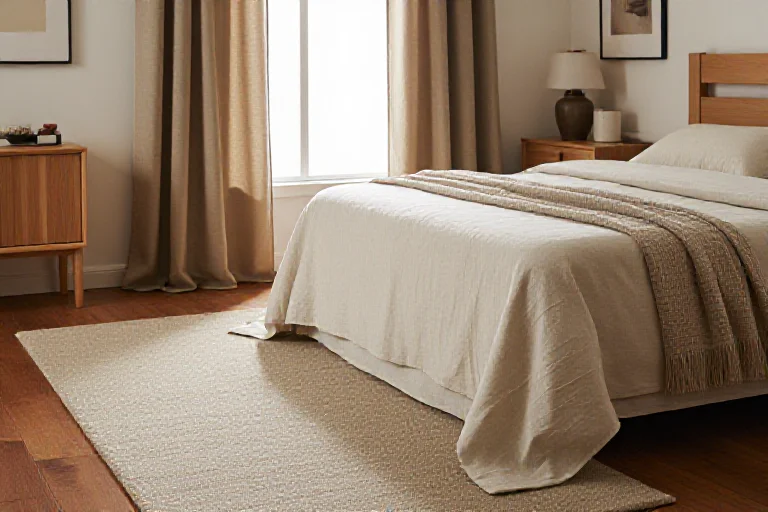
You can buy three beautiful bedroom products and still end up with a bedroom that looks wrong.
A beautiful duvet.
A beautiful rug.
Beautiful curtains.
Individually, they work.
Together, they compete.
That is because bedding, rugs, and curtains are not really three separate decorating decisions.
Together, they form one of the largest visual systems in the bedroom.
The trick is not making them match.
It is making them relate. This is also a common reason why a bedroom still feels incomplete, even when every individual piece is beautiful.
Start with the largest visual element
For most bedrooms, that is the bed.
The bedding is usually the easiest place to establish the main color and texture.
Choose the bedding first.
Then use the rug and curtains to support it.
For example:
Cream bedding
→ oatmeal rug
→ warm beige curtains
This feels cohesive because the three pieces share a visual temperature.
You could also use:
Deep olive bedding
→ neutral beige rug
→ cream curtains
Here, the bedding provides the stronger color while the other two elements calm it down.
Do not match everything
Matching bedding, curtains, and rugs exactly can make a bedroom feel like a furniture showroom.
Instead, use a relationship between the pieces.
Think:
Same color family
rather than
Same color.
Or:
Similar warmth
rather than
Identical shade.
This gives the room variation.
Use the 60–30–10 idea carefully
You may have heard of the 60–30–10 color rule.
It can be useful, but you do not need to follow it mathematically.
Think of it more as:
Dominant color
Supporting color
Small accent
For a warm natural bedroom:
60% → cream / warm white
30% → beige / wood
10% → olive or brown
This prevents every major surface from competing for attention.
Choose the rug based on the bed
The rug should visually connect to the bed rather than float somewhere nearby.
One common mistake is using a rug that is too small.
A tiny rug at the foot of a large bed can make the room feel fragmented.
A larger rug extending beyond the sides of the bed usually creates a stronger visual anchor.
The exact size depends on the room and bed, but the principle is simple:
The rug should have enough scale to relate to the bed.
Curtains should connect the room vertically
Bedding and rugs occupy the lower part of the room.
Curtains introduce color and texture higher up.
That makes them useful for balancing the composition.
For example:
Cream bedding
Natural rug
Warm beige curtains
The room becomes visually connected from floor to ceiling.
If the curtains introduce a completely unrelated cool tone, the room may feel divided.
Think about color temperature
This is one of the easiest ways to accidentally create a disconnected bedroom.
Consider:
Warm beige bedding
versus
Blue-gray curtains
versus
Cool gray rug
None of those colors is necessarily bad.
Together, however, they may create competing temperatures.
Instead, choose whether your room is primarily:
Warm
Cool
or
Neutral with warm accents.
For the kind of cozy bedroom atmosphere we focus on, warm neutrals are usually the easiest foundation. If your room currently leans cool, this guide to making a bedroom feel warmer at night covers the lighting side of the same problem.
Texture is as important as color
Imagine two rooms.
Room A
Cream bedding.
Cream rug.
Cream curtains.
Everything matches.
But everything is smooth.
Room B
Linen bedding.
Woven rug.
Soft cotton curtains.
Same general colors.
The second room will usually feel much more dimensional.
This is why you should think about texture whenever you are working with neutral colors. For a deeper look at building depth with wood, linen, and woven materials, see these natural bedroom ideas using wood, linen, and texture.
Use one contrast
A bedroom does not have to be entirely soft.
A little contrast helps.
For example:
- Dark wood nightstand
- Black picture frame
- Deep brown throw
- Brass lamp
- Dark green cushion
One stronger element gives the eye something to focus on.
Without contrast, neutral rooms can sometimes become visually flat.
What if you already own everything?
You do not need to replace all three pieces.
Instead, identify the one element that feels most disconnected.
Ask:
Is it the color?
The texture?
The scale?
The pattern?
The visual temperature?
Usually, only one of these is causing the biggest problem.
For example, if your bedding and rug work beautifully but your curtains are a completely different color family, replace the curtains rather than redesigning the entire bedroom. The same principle applies when you want to refresh a bedroom without replacing furniture.
A few combinations that are hard to get wrong
Warm Minimal
Cream bedding
Oatmeal rug
Linen beige curtains
Light wood
Black or dark brown accent
Natural
White or cream bedding
Jute or woven rug
Natural linen curtains
Oak furniture
Muted olive accent
Cozy
Warm beige bedding
Plush neutral rug
Soft textured curtains
Warm wood
Amber-toned lighting
Moody
Deep green or brown bedding
Warm neutral rug
Cream or darker curtains
Dark wood
Warm brass lighting
Frequently Asked Questions
Should bedroom curtains match the bedding?
They do not need to match exactly. They should generally work within the same color family or visual temperature.
Should a bedroom rug be lighter or darker than the bed?
Either can work. A lighter rug can soften a dark bed, while a darker rug can anchor a lighter bed.
What color rug goes with beige bedding?
Cream, oatmeal, taupe, natural woven tones, muted brown, and soft earthy colors are versatile choices.
Should bedroom furniture match the bedding?
No. Furniture, bedding, rugs, and curtains can have different materials and colors as long as they share some visual relationship.
How do I make mismatched bedroom decor look intentional?
Repeat one or two colors or materials across the room. Repetition creates cohesion without requiring everything to match.
The easiest rule to remember
Do not ask:
“Do these three things match?”
Ask:
“Would these three things make sense in the same room?”
That small change in thinking makes bedroom shopping much easier.
You are not building a collection of individual products.
You are building one environment.
The Scene Connection
This is exactly how our Cozy Bedroom and Natural Bedroom scenes are built.
Instead of choosing every item independently, we think about how bedding, lighting, rugs, furniture, and texture work together.
Because the best bedroom products are not necessarily the ones that look best alone.
They are the ones that make the whole room feel better.
Explore the Bedroom Scenes →
See it put together
Natural Bedroom
A warm bedroom layered with natural materials, earthy neutrals, and quiet organic textures.
Explore this scene →